
Artificial Intelligence is no longer a special advantage reserved for software developers, technology companies or people who speak fluent “computer language.” It is rapidly becoming a basic professional skill—just like using email, creating presentations or conducting online research.
From marketing and media production to finance, customer service, education, administration and entrepreneurship, AI is changing how professionals research, communicate, create and solve problems.
The World Economic Forum identifies AI and big data among the fastest-growing workplace skills, while employers expect approximately 39% of the key skills required in the labour market to change by 2030. Yet the professionals benefiting most from this shift are not necessarily the most technical people. They are those who understand how to combine AI with sound judgement, creativity and practical workplace experience.
Here are eight important secrets you need to know about the AI skills reshaping today’s professional space.
1. AI Literacy Is Becoming a Basic Professional Requirement
You do not need to become a programmer or machine-learning engineer to remain relevant. However, you need to understand what AI can do, where it can be applied and where its limitations begin.
AI literacy involves knowing how to:
-
Select the appropriate AI tool for a task
-
Give clear instructions to AI systems
-
Interpret and improve AI-generated results
-
Recognise inaccurate or misleading information
-
Protect confidential business and customer data
-
Use AI ethically and responsibly
Just as every professional does not need to understand how a computer processor works before using a laptop, you do not need to understand every technical detail behind AI. You need enough knowledge to use it intelligently.
2. Prompt Engineering Is Really the Art of Giving Clear Instructions
Many people believe AI produces poor results because the technology is unreliable. Sometimes that is true. But very often, the real problem is an unclear prompt.
A vague instruction such as “write something about my business” will usually produce generic content.
A professional prompt should clearly communicate:
-
The task to be completed
-
The intended audience
-
Relevant background information
-
The required tone and style
-
The preferred structure or format
-
Important limitations
-
An example of the expected result
Prompt engineering is not about memorising clever formulas. It is about learning how to brief AI as clearly as you would brief a competent employee, designer, writer or consultant.
If the instruction is confused, the output will probably arrive wearing the same confusion.
3. Knowing the Right Tool Matters More Than Knowing Many Tools
New AI platforms appear almost every week. Trying to master all of them is neither realistic nor productive.
The real skill is knowing which category of tool is appropriate for a particular job.
For example:
-
Writing tools can support research, reports, proposals and content development.
-
Image-generation tools can create marketing concepts and visual assets.
-
Video tools can assist with editing, animation and production.
-
Audio tools can improve recordings, generate voiceovers and clean background noise.
-
Presentation tools can organise ideas into professional slides.
-
Automation tools can connect repetitive business processes.
-
Data-analysis tools can identify patterns and support decision-making.
A professional with five carefully selected tools and a clear workflow will usually outperform someone who has opened accounts on 40 platforms but cannot complete one solid project.
4. The Biggest Advantage Comes From Redesigning Your Workflow
Using AI to complete one isolated task is useful. Building AI into an entire workflow is where the greater value begins.
A marketing professional, for example, can use AI to:
-
Research an audience
-
Develop campaign concepts
-
Create a content calendar
-
Draft platform-specific content
-
Generate visual directions
-
Produce video scripts
-
Analyse campaign performance
-
Recommend improvements
The goal is not merely to perform the same work a little faster. It is to reconsider how the work should be done from beginning to end.
Microsoft’s 2026 Work Trend Index reports that 66% of surveyed AI users said the technology allowed them to spend more time on high-value work, while 58% said they were producing work they could not have produced a year earlier. Microsoft Work Trend Index
5. Your Professional Experience Makes AI More Valuable
AI can generate information, but it does not automatically understand your organisation, customers, local market, values or professional standards.
This is where human experience becomes extremely important.
Two people may use the same AI tool and receive completely different results because one person knows how to provide relevant context, identify weak ideas and refine the output.
A skilled filmmaker will evaluate an AI-generated video differently from a beginner. An experienced marketer will recognise when a campaign idea does not fit the target audience. A trained accountant will notice when an AI-generated financial interpretation is questionable.
AI does not erase professional experience. Used properly, it multiplies it.
6. Verification Is an AI Skill—Not an Optional Final Step
AI can write confidently while being completely wrong. It may invent statistics, misrepresent sources, misunderstand instructions or generate information that sounds accurate but cannot be verified.
Professionals must learn to:
-
Check important claims against credible sources
-
Confirm names, dates, figures and quotations
-
Review calculations
-
Examine content for bias
-
Test recommendations before implementation
-
Apply human approval to important decisions
This is especially critical in healthcare, finance, law, education, journalism and corporate communication.
Speed without accuracy is not productivity. It is simply a faster route to an embarrassing mistake.
7. Human Skills Are Becoming More Valuable, Not Less
The rise of AI does not mean human abilities are becoming irrelevant. It means routine execution is becoming easier, while distinctly human skills are becoming more valuable.
These skills include:
-
Creative thinking
-
Emotional intelligence
-
Leadership
-
Communication
-
Collaboration
-
Ethical judgement
-
Adaptability
-
Strategic thinking
-
Curiosity and continuous learning
The World Economic Forum notes that creative thinking, resilience, flexibility, leadership and collaboration will remain critical alongside technological skills. World Economic Forum
AI may help you prepare a presentation, but it cannot replace the trust you build while delivering it. It can analyse customer feedback, but it cannot genuinely care about the customer. It can generate options, but responsibility for the final decision still belongs to a human being.
8. Practical Evidence Will Matter More Than an AI Certificate
Completing an AI course is helpful, but employers and clients increasingly want proof that you can apply what you have learned.
Instead of merely listing “AI skills” on your CV, build a small portfolio showing how you have used AI to:
-
Develop a marketing campaign
-
Improve a business process
-
Produce a professional video
-
Conduct structured research
-
Create an automated customer-response system
-
Analyse business data
-
Design a presentation
-
Reduce the time required for a repetitive task
Document the original problem, the AI-assisted process, your human contribution and the final result.
The future will reward professionals who can demonstrate measurable value—not those who simply mention ChatGPT in every conversation like a newly discovered family member.
The Real Secret: AI Will Not Replace Every Professional
The more accurate statement is that professionals who know how to use AI may gain a serious advantage over those who refuse to learn it.
However, using AI carelessly is not enough. The competitive edge comes from combining technological ability with professional knowledge, creativity, verification and ethical judgement.
AI should not reduce the quality of your thinking. It should increase the quality, speed and range of what you can accomplish.
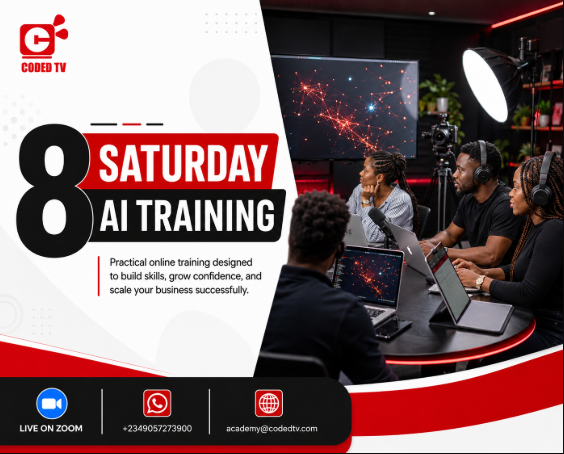
Start Building Practical AI Skills with Coded TV
At Coded TV, we help professionals, entrepreneurs, creators and organisations move beyond AI curiosity to practical application.
Our AI Tools and Creative Training programmes cover:
-
AI tools for work and business
-
Prompt engineering
-
AI-powered research and content creation
-
Image and video generation
-
Professional video editing
-
Digital marketing applications
-
Voice and visual production
-
Business productivity and automation
-
Responsible and effective use of AI
Whether you want to improve your career, grow your business, strengthen your team or introduce AI into your organisation, now is the time to build the right skills.
Contact Coded TV today to enquire about our upcoming AI Tools and Creative Training or request a customised corporate training programme.
Which of these eight AI skills would make the biggest difference in your work today? Share your answer in the comments.