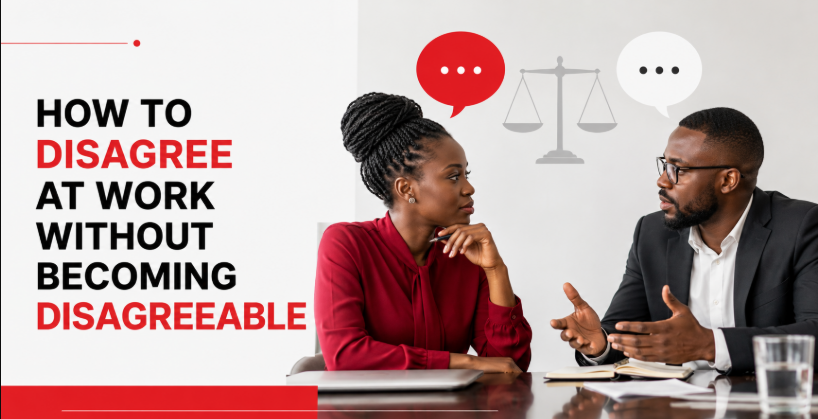
Healthy teams need disagreement. If everyone remains silent to protect appearances, weak ideas survive and costly mistakes grow. The issue is not whether people disagree; it is whether they know how to do it with respect.
Begin by stating the shared goal. Then challenge the evidence, assumption or likely consequence—not the person’s intelligence or motive. Ask questions before making accusations. A sentence such as ‘What information led us to this conclusion?’ opens a door that ‘This makes no sense’ immediately closes.
Separate conviction from ego
Disagreement becomes destructive when the goal changes from solving a problem to defeating a person. Once dignity is threatened, people defend themselves instead of examining evidence.
Strong professionals can summarise an opposing view fairly before challenging it. This proves they listened and often reveals the real disagreement: facts, priorities, risk tolerance or timing. Precision lowers emotional heat.
Choose the right setting. Correcting a colleague publicly when a private conversation would work can turn a business issue into a battle for dignity. Listen to the full response and be willing to change your position when better evidence appears.
Professional maturity is not passive agreement. It is the ability to speak truth without unnecessary cruelty and to receive correction without treating it as humiliation.
Practical application
- Begin with the shared objective and the point you agree on.
- Use evidence and specific consequences, not labels or sarcasm.
- End with a decision, owner and next step so the conflict produces progress.
Respectful disagreement is not weakness. It is disciplined courage—the ability to protect both truth and relationship.
Clear communication becomes even more important when teams adopt AI tools. Learn practical, responsible workflows during Coded TV’s 8 Saturday AI Training.
Reader question: What is one practical change you will make after reading this?